
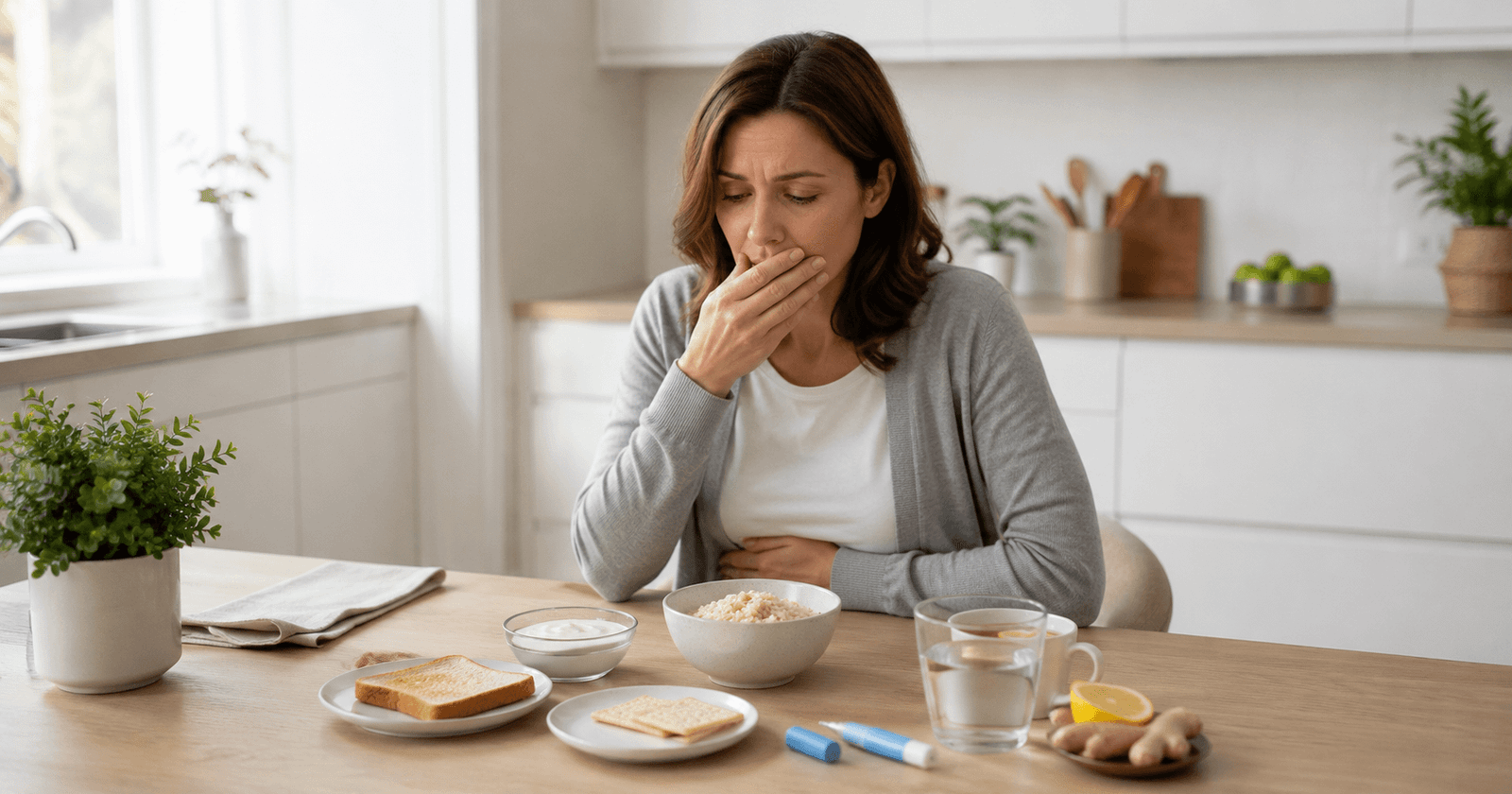
GLP-1 nausea can occur especially at the beginning of treatment or after a dose increase.Sometimes it is mild and passes quickly. Other times, simply smelling food or taking a few bites can be enough to make you feel unable to continue eating. [1–4]
The problem starts when, in trying to avoid nausea, you end up eating and drinking so little that it becomes difficult to meet even your basic nutritional needs. On these days, you do not need a “perfect” meal. You need simple foods, small portions and a structure that you can actually tolerate.
Important: This article is for informational and educational purposes only. It does not recommend or prescribe medication and is not a substitute for medical advice. Do not change your dose or stop treatment without speaking to the doctor who prescribed it. If you have diabetes and also use other medicines that lower blood glucose, any significant reduction in food intake should be discussed with your medical team.
Table of Contents
Why can nausea occur during GLP-1 treatment?
Nausea is one of the known digestive side effects of treatments with semaglutide and tirzepatide. It may be more noticeable when treatment is first started or while the dose is being increased and, for many people, becomes less troublesome as the body adjusts. [1–4]
At the same time, treatment can increase feelings of fullness and make a portion that once seemed normal feel simply too large.
So, if nausea appears, one of the first things worth looking at is how much food you are eating at one time.
What to eat when Wegovy, Ozempic or Mounjaro makes you feel nauseous
Start with a small portion
Do not try to finish a portion simply because that is how much you used to eat before treatment.
Start with a small amount, eat slowly and stop when you begin to feel full. If you are hungry again later, you can have another small amount. Smaller portions spread throughout the day are often easier to tolerate than one or two very large meals. [4]
Choose simple, lower-fat foods for a while
On a day when nausea is more intense, you do not need to force yourself to eat complicated meals.
Depending on what you tolerate, you could try:
- toast or plain crackers;
- rice or potato;
- well-cooked oats;
- plain yoghurt;
- fresh cheese;
- egg;
- lean meat or white fish, in a small portion;
- cooked vegetables;
- a simple soup.
Very fatty meals, fried foods and heavy sauces can be more difficult to tolerate when you already feel nauseous. [4]
This does not mean you need to remove fat from your diet. Sometimes simply reducing the amount at that particular meal is enough.
If the smell of food makes you feel sick, try changing the temperature
Hot food usually has a stronger smell. If simply being in the kitchen makes you lose your appetite, try foods that are cold or at room temperature.
A yoghurt, some fresh cheese with a few crackers or a small portion of food that has been allowed to cool may be easier to tolerate than a very hot meal.
This is not a rule for everyone. If you find a warm soup easier to tolerate, there is no reason to avoid it.
How to stay hydrated when you feel nauseous
Drinking a large glass all at once can be difficult when your stomach already feels full.
Try small, frequent sips throughout the day instead. Water should remain the main source of hydration, but other fluids that you tolerate well can also help.
If drinking during meals makes you feel overly full or worsens your nausea, try drinking more between meals instead. [4]
The important thing is not to end up avoiding fluids almost completely simply because you do not feel thirsty.
What can make nausea worse during GLP-1 treatment?
There is no single list that applies to everyone, but some situations are more likely to cause problems:
- very large portions;
- eating too quickly;
- continuing to eat after you already feel full;
- very fatty or fried foods;
- strong food smells;
- very spicy meals, if you notice they make you feel worse;
- drinking a large amount of fluid very quickly.
Do not turn every episode of nausea into another food restriction. Sometimes the problem is the amount of food or the timing of the meal rather than the food itself.
For a broader look at portion sizes, protein, hydration and meal planning, read Nutrition During GLP-1 Treatment: What to Eat When Taking Wegovy, Ozempic or Mounjaro.
What if you end up eating very little?
On a difficult day, simplifying your meals is perfectly reasonable. The problem is when your food intake stays very low for several days or nausea prevents you from drinking enough fluids.
Do not force yourself to eat a large portion of meat or drink a very filling shake simply to reach a particular protein target. Start with what you can tolerate and gradually return to a more varied diet as you begin to feel better.
If your bowel movements also slow down, read GLP-1 constipation: what to eat when taking Wegovy, Ozempic or Mounjaro.
When should you contact your doctor about nausea?
Speak to your doctor if the nausea:
- persists or gets worse;
- becomes much more intense after a dose increase;
- prevents you from eating enough;
- is accompanied by repeated vomiting;
- makes it difficult to stay hydrated.
Seek prompt medical assessment if you cannot keep fluids down, develop significant dizziness or other signs of dehydration, or have severe and persistent abdominal pain, with or without vomiting. [1–4]
Do not automatically assume that every episode of nausea or abdominal pain is “normal because of the injection”, and do not change your treatment dose on your own.
Simpler meals when your appetite is reduced
When portions become small, it can be difficult to find meals every day that are both nutritious and easy to tolerate.
If you prefer to start from an already organised meal structure, you can look at Metabolic Reset for Women or Metabolic Reset for Men. Meals and portion sizes should be adapted according to how well you tolerate them on that particular day.
The meal plans do not treat nausea and do not replace medical advice.
On difficult days, the goal is not to eat perfectly. Start with small portions, choose simple foods, drink fluids gradually and do not force yourself to continue eating once you feel full. As the nausea improves, gradually return to as varied a diet as possible.